 [The end of my stints as photo critic and columnist for the Village Voice (1968-73) and the New York Times (1970-74) effectively terminated my running commentary on the emergent photo scene in New York City and, more broadly, across the U.S.
For the first time in my professional life I could write whatever I wanted to write, developing my ideas at my own pace, employing a more essayistic style, without needing to tie a given piece to some newsworthy occasion. (How I would make a living at this I’d have to figure out as I went along, of course.)
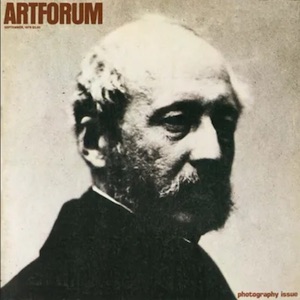
Artforum, September 1976
One result of this transition took the form of the essay below, published exactly 50 years ago in Artforum. Half a century on, this stands as my most widely circulated, most anthologized, most frequently assigned, and most cited essay. This article first appeared in print in Artforum, 15:1, September 1976, pp. 55-61. Subsequently I republished it in my 1979 collection, Light Readings: A Photography Critic’s Writings, 1968-78. This is the first of two parts. This is the second half of the essay; click here for Part 1.— A.D.C.]
•
The Directorial Mode: Notes Toward a Definition (b)
… The problematic aspect of straight photography’s relationship to directorial activity is not the viability of either stance; both are equal in the length of their traditions and the population densities of their pantheons. Rather, it is the presumption of moral righteousness which has accrued to purism, above and beyond its obvious legitimacy as a creative choice. This posture is not only irrelevant and — as the above examples indicate — often hypocritical, but baseless.
Even if all purists adhered strictly to the tenet that any tampering with reality taints their imagery’s innocence and saps its vital bodily fluids, the difference between that passive approach and a more aggressive, initiatory participation in the mise en image is — though highly significant within the medium — still only one of degree. We must recognize that the interruption of a fluidly and ceaselessly moving three-dimensional Gestalt and its reduction to a static two-dimensional abstraction is a tampering with reality of such magnitude that the only virginity one could claim for any instance of it would be strictly technical at best.
•
I am not a Historian, I create History. These images are anti-decisive movement. It is possible to create any image one thinks of; this possibility, of course, is contingent on being able to think and create. The greatest potential source of photographic imagery is the mind.
This statement was made by Les Krims in 1969.[1] Krims has been working in the directorial mode (he refers to his works as “fictions”) for over a decade. He has explored it thoroughly and prolifically, enough so that the above quotation could serve as a succinct credo for all those who use the camera in this fashion.
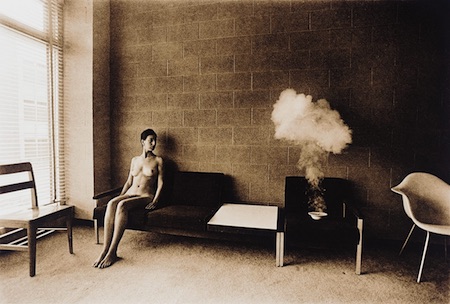
Les Krims, Untitled (ca. 1971)
Krims is by no means the first photographer to take this position, nor is he the only one of his generation to do so. Yet it is apparent that, both inside and outside photographic circles, there is little recognition that there does exist a tradition of directorial photography. Certainly you would not know it from reading any of the existing histories of the medium. This widespread unawareness is traceable to two sources: the biases and politics of photographic historiography to date, and the ignorance about photography of most of the art critics who have dealt with the medium.
The consequences have been that photographers with a predilection for this approach to image-making have had to undertake it in the face of outright hostility from a purist-oriented photography establishment, with no sense of precedent to sustain their endeavors; and that the current crop of conceptual artists employing photography directorially are on the whole even less informed in this regard than their contemporaries in photography, and thus have no concern about and no accountability for the frequency with which they duplicate and plagiarize previous achievements in this mode.
•
Perhaps the first large-scale flowering of directorial photography — the point at which such work entered the average Western home and became an intrinsic part of our cultural experience of the medium — came with the introduction of the stereopticon viewer and the stereographic image, circa 1850. Stereo photographs of all kinds, mass-produced by the millions, became a commonplace form of entertainment and education during the next three decades, and survived as such well into the twentieth century. Among the standard genres of stereo imagery was the staged tableau, often presented sequentially and narratively; the scenarios ranged from Biblical episodes and classics of literature to domestic comedies and schoolboy pranks.
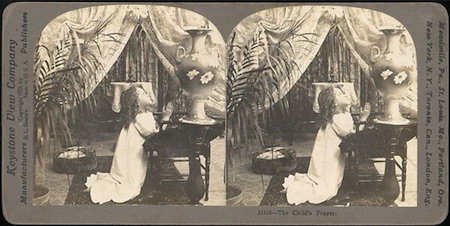
Photographer unknown, The Child’s Prayer, Keystone View Co. stereograph (1904)
•
Through the stereograph, Western culture received its first wide exposure to fictionalized photographs. This initial experience has been followed by many others: erotic, fashion, and advertising photography are only a few of the forms which have been, by and large, explicitly directorial from their inception. Most of these, however, are not considered “serious” usages of the medium; their commercial function and/or popular appeal presumably render them insignificant, even though they reach and influence a vast audience. (As I noted before, the public has never been unwilling to look at photographs.)
Within the more self-conscious arena of Art Photography, whose audience has always been comparatively scant, the advent of directorial photography as an active mode and an acknowledged alternative to realism dates back to the same period — the 1850s — and the work of two men: O. G. Rejlander and Henry Peach Robinson.[2] Both staged events for the purpose of making images thereof — mostly genre scenes and religious allegories; both used the process of combination printing, involving the superimposition of one negative on another, which fictionalized the resulting print even further.
Their work was the subject of heated debate from all sources — photographers, artists, art critics, and the public as well. Until recently, the sentimentality of the most popular of their images (Rejlander’s “Two Ways of Life” and Robinson’s “Fading Away”) was used by photo-historians as a basis for dismissing their entire oeuvres and their way of working as well. (Re-examination of their output turns up some astonishing, little-seen imagery; in Rejlander’s case, for instance, “The Dream,” “The Juggler,” and “Woman Holding a Pair of Feet.”)
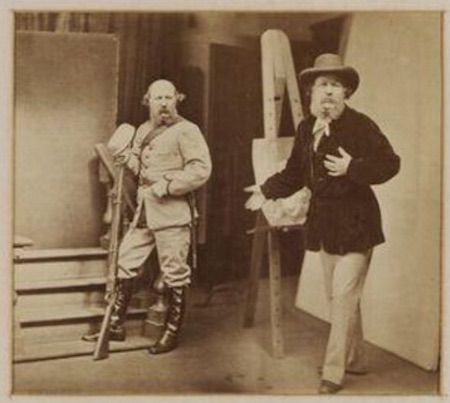
O. G. Rejlander, “O.G.R. the Artist Introduces O.G.R. the Volunteer,” ca. 1871
•
Beginning in 1864, the Victorian photographer Julia Margaret Cameron also produced an extended body of directorial work in which she blended, for better or worse, current literary themes and attitudes with the visual conventions of Pre-Raphaelite painting. Some of her images were studio portraits of famous artists and literati; others were enactments of scenes from literature. Also sentimental, for which they too have been often dismissed, they are nonetheless powerful images whose illusions are effective despite — and perhaps even because of — the viewer’s knowledge of what was “really happening” at the time.
Subsequently, there rose and flourished the photographic movement generally known as pictorialism. That word itself is problematic, even though the dictionary definition is non-judgmental. (Certainly as a term it is less absolute, and therefore less enticing to true believers, than its ostensible opposite in photography, purism.)
At different times pictorialism has had different meanings and implications in photography. Presently it is employed to describe bland, pretty, technically expert executions of such clichés as peasants tilling the fields, fisherfolk mending nets, and sailboats in the sunset, still being cranked out by mentally superannuated hobbyists. As such, it is essentially derogatory. Initially, however, it had quite a different import; it indicated adherence to a set of conventions — prescribing styles and subject matter — which were thought to be essential to any work of fine art, not just art photographs.
That it became trapped within those conventions is regrettable, though doubtless inevitable. However, an attitude toward the medium of photography underlay the pictorial impulse, and that attitude is of great importance. It could be summarized thus: photography is only a means. Whatever tools or methods are required for the full realization of the image as conceived should be at the disposal of the imagemaker, and should not be withheld on the basis of abstract principle. Man Ray said much the same thing: “A certain amount of contempt for the material employed to express an idea is indispensible to the purest realization of this idea.”
Pictorialism, then, was the first photographic movement to oppose the imposition of realism as a moral imperative. The pictorialists felt free to exercise full control over the appearance of the final image/object and, equally, over the event it described. Practitioners staged events — often elaborate ones — for their cameras, and resorted to every device from specially made soft-focus lenses to handwork on the negative in order to produce a final print that matched their vision. Much of the imagery they created was, and is, extremely silly; much of it was, and is still, beautiful and strong. For all their excesses, Anne Brigman, Clarence White, F. Holland Day, Gertrude Käsebier, and many others produced some remarkable and durable work.
•
Creatively, the kind of photography we now call pictorialism reached its peak during and shortly after the Photo-Secession era — from the turn of the century through the early 1920s. Then it began to come up against the purist attitude. The clash between these two opposing camps came to a head in the pages of Camera Craft, a West Coast magazine, in the early Thirties, in the form of a heated exchange of letters between various members and sympathizers of the f.64 movement (among them Ansel Adams and Willard Van Dyke) and William Mortensen.
Mortensen was a practitioner of and articulate spokesman for pictorialism, though by the time he achieved recognition the form was already in decline. In the minds of most, the purist-pictorialist schism was simplistically conceptualized as hard sharp prints on glossy paper versus soft blurry prints on matte paper. The actual issue at stake was far more complex: it concerned the right of the image-maker to generate every aspect of a photographic image, even to create a “false” reality if required. (Mortensen himself worked almost entirely in the studio, creating elaborate symbolist allegories filled with demons, grotesques, and women both ravishing and ravaged.)
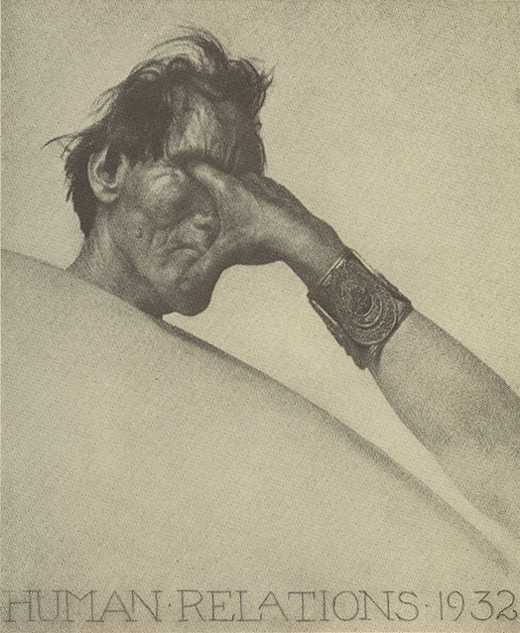
William Mortensen, “Human Relations, 1932”
•
The debate was a draw, at least in retrospect, but second-stage Hegelianism won the day: the aesthetic pendulum swung to purism, and pictorialism fell into disrepute. Mortensen — who, in addition to this debate, was widely published in photography magazines and authored a series of how-to books which are to pictorialism what Ansel Adams’s instructional volumes are to purism — was actually purged from the history of photography in what seems a deliberate attempt to break the movement’s back.[3]
For the next three decades — until the late 1960s, in fact — there were commercial outlets for certain kinds of directorial images, but any photographers working directorially in a non-commercial context did so over the vociferous opposition of most of their peers and of the aesthetic-economic establishment which controls the medium’s access to the public and to money. Still, some persevered: Clarence John Laughlin, making his Southern Gothic image-text pieces in New Orleans; Edmund Teske, pouring out his passionate homoerotic lyrics in Los Angeles; Ralph Eugene Meatyard photographing the ghoulish masked charades of his family and friends in Lexington, Kentucky; Jerry Uelsmann resurrecting lost techniques in Florida. There were others too, hoeing that hard row.
The 1960s were a time of ferment in photography, as in most other media. Old attitudes and assumptions were put to the test. Purism, it was found by a sizable new generation of photographers, was still viable as a chosen approach but restrictive as an absolute. Even so, old attitudes die hard, and these younger photographers found themselves facing an establishment and a public that was so accustomed to equating creative photography with purism that it was (and still is) considerably perplexed by anything else.
But they too have persevered. It would be difficult to compile a complete list of those working in this mode at this time — there are a great many, and the number is increasing rapidly. Les Krims and Duane Michals must certainly be counted among the pioneers of their generation in this form; both are prolific, both have published and exhibited widely, both are reference points for the current generation of younger photographers and are obvious sources for much of the mediocre directorial photography which passes for “conceptual art” nowadays.
John Pfahl, Ken Josephson, and Joseph Jachna have all produced extended series in which they enter into or visibly alter the landscape, with related hermeneutic inquiries into the illusionism of the medium. Lee Friedlander (in Self-Portrait), Lucas Samaras, and the late Pierre Molinier have all used the camera as a dramatic device, in front of which their fantasies and obsessions are acted out. Eikoh Hosoe, Richard Kirstel, Arthur Tress, Adál Maldonado, Ed Sievers, Doug Stewart, Paul Diamond, Ralph Gibson, Irina Ionesco, Mike Mandel, Ed Ruscha, William Wegman, Robert Cumming, and Bruce Nauman (among others) also have things in common.
 This article was conceived as an examination of those connections, with a historical prologue to set current ideas in their full context. The prologue has grown to engulf the main text and is still too summary. But, to conclude: willingly or no, whether or not they consider themselves “photographers” or “artists” or whatever, these individuals and many others are exploring the same field of ideas. That field of ideas is built into and springs from the medium of photography itself; it has a history and tradition of its own which is operative on many levels of our culture.
There is no direct equation between ignorance of history and originality. Disclaiming one’s ancestry does not eliminate it. It is regrettable that in most cases these creative intelligences are not aware of their lineage; it seems foolish that in many cases they attempt to deny it. The moment would seem to be ripe for them to acknowledge their common sources and mutual concerns; their real differences will make themselves apparent in due time.
(Part 1 I 2)
•
Notes:
[1] In a letter published in Camera Mainichi, no. 8 (Japan), 1970.
[2] Strangely, in 1888 a public controversy between Robinson and Peter Henry Emerson began over these same issues. Emerson advocated a purist approach to the medium: no interference with the external event, no multiple negatives, no retouching (though, inconsistently, he allowed for the “burning in” of fake clouds, since the real ones would not register on the slow films of the day). Emerson’s position was called “naturalism”; Robinson’s was called realism!
[3] From the first one in 1937 to the most recent of 1964, no edition of Beaumont Newhall’s The History of Photography: From 1839 to the Present Day — the standard reference in the field — so much as mentions the name of William Mortensen. It will be instructive to see whether the forthcoming edition — a major revision supported by the Guggenheim Foundation — rectifies this omission.
In fact, none of the books on the history of twentieth-century photography refers to Mortensen. If this could be considered even an oversight, the only questions it would raise would concern standards of scholarship. Since it cannot be construed as anything less than a conscious choice, however, the issue is not only competence but professional ethicality.
•
Special offer: If you want me to either continue pursuing a particular subject or give you a break and (for one post) write on a topic — my choice — other than the current main story, make a donation of $50 via the PayPal widget below, indicating your preference in a note accompanying your donation. I’ll credit you as that new post’s sponsor, and link to a website of your choosing.
And, as a bonus, I’ll send you a signed copy of my new book, poetic license / poetic justice — published under my full name, Allan Douglass Coleman, which I use for my creative writing.
[donateplus]