 Passing the Torch
Nowadays, with some regularity, I experience the pleasant surprise of a younger scholar contacting me regarding something I published decades ago — even going all the way back to the late ’60s and early ’70s. My very first column in the New York Times, about a sprawling 1970 group show from what was then the Soviet Union (a Russian scholar). A 1973 Times review of a retrospective exhibition by the Hungarian emigré photojournalist Lucien Aigner (a Hungarian scholar). My 1974 Times review of John Szarkowski’s 1974 MoMA survey of “New Japanese Photography” (a Japanese scholar). The Society for Photographic Education in the 1970s and early ’80s (an Israeli scholar).
In some cases we pursue their questions via email correspondence, but in others we do so via Zoom and not infrequently in person. Either way, they typically not only want to go into what I wrote but also how I came to write it, which makes these engagements into trips down memory lane. As a result, I become keenly aware of what I’ve lost to the years in between; but I also enjoy the challenge of seeing how much context I can still dredge up despite the interval. Plus, of course, what I can add that has accrued since.
I suppose this represents my own personal validation of chaos theory: A critic flapping his lips in New York City circa 1970 can affect a research project across the ocean 50-odd years later.
•
Some Thoughts on the Digital Millennium Copyright Act
I’m a member of only one listserv — photohistory@groups.io, moderated by the Capa D-Day project’s own Rob McElroy. I don’t contribute to it often, but in mid-July the subject of protecting online material from copyright infringement came up, and I mentioned the 1998 Digital Millennium Copyright Act (DMCA) as a useful tool.
 One member of the group responded with the assertion that the DMCA was a hoax, which misapprehension I corrected with a link to the U.S. Copyright Office’s explanation of this 1998 law. I added the following:
I’ve actually experienced relatively little copyright infringement in 60 years of print and online publishing. Most of it proved rectifiable with a simple request to remove the material or provide compensation for the usage.
I’ve only had to use the DMCA complaint in a few cases where the infringer claimed entitlement via “fair use” of an entire essay, and refused to take that text down when asked. …
It takes just a few minutes to create a boilerplate firm but cordial request to take unauthorized material down (or compensate you for the usage), and just a few minutes more to retool that as a boilerplate DMCA complaint. Makes it easy to deal with these situations as they come up. …
P.S. Many large sites that aggregate content actually include a built-in DMCA notice page for filing a complaint. Usually it’s at the bottom of their home page, along with their address and “Contact Us” links. If not, the site’s search field will find it.
Struck by this, one of the PhotoHistory group’s members, Antonella Russo, contacted me. Russo, an Italian historian and curator specializing in photography and architecture, most recently published the monograph Italian Neorealist Photography: Its Legacy and Aftermath (Routledge, 2022), an excellent study of a hitherto ignored genre and period. She has her own website (in Italian only), a subsection of which she devotes to the magazine Scintille, which periodically publishes video interviews on photo-related subjects.
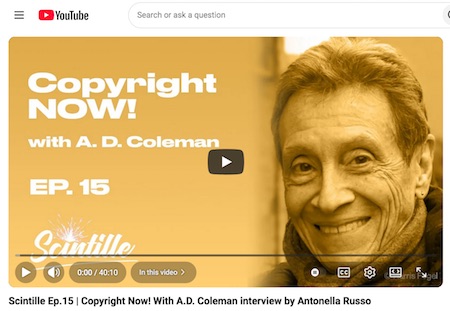
A. D. Coleman, Scintille interview (2026), screenshot
Russo invited me to elaborate on the DMCA and other intellectual property issues for her viewers. The outcome, an edited 40-minute conversation published on August 9, 2026, appears at YouTube under the title “Scintille Ep. 15 | Copyright Now! With A. D. Coleman.” In addition to discussing the DMCA, we dip into such topics as the differences between digital and analog photography and the impact of AI on the medium.
As I understand it, while each European country has its own copyright laws, and most subscribe to the International Copyright Convention (ICC), no European country has an equivalent to the DMCA, which is specific to online platforms operating in the U.S. For information pertaining to the situation of copyright and online IP law across the pond, see “DMCA Compliance for Platforms Operating in Europe — Key Differences,” a useful primer.
Given Scintille‘s primarily Italian audience, I kept my explanation of how the DMCA works fairly basic. (Both Russo and I spoke in English.) If you want to learn more about it, start with the U.S. Copyright Office’s DMCA page. A few more explainers:
For anyone dealing with copyright infringement within the U.S. (which includes any website with a U.S.-based server and/or domain-name registrar), the DMCA provides a simple, effective, and user-friendly instrument with which to protect pirated IP.
•
My steadfast protection of my copyright and subsidiary rights notwithstanding, it pleases me to know that all my published books — with the exception of Tarnished Silver (1996) — exist in digitized form available for short-term loan (read-only) at the Internet Archive. This includes The Grotesque in Photography (1977); both editions of Light Readings (1978, 1998), the first edition in three different uploads; The Photography A-V Program Directory (1980); Critical Focus (1995); Looking at Photographs: Animals (1995), my book for children; Depth of Field (1998); and The Digital Evolution (1998). Plus a handful of monographs and anthologies to which I contributed essays. The Internet Archive itself produced these digital additions to their holdings beginning in 2020, with the most recent upload dating from March 2026.
These digital editions have appeared at the Internet Archive without my permission, true. But I accept their presence at this resource, for the following reasons:
- I could request their removal and, according to the project’s rules, they’d remove them within 72 hours. So the remedy’s baked in and always available.
- Online access is strictly limited to 14-day loans with read-only permission: No printing-out, no copy/paste of extracts, no screenshots.
- You can download pdf and epub versions, but these require a special LCP-compatible reader. LCP protection (short for Licensed Content Protection) is a Digital Rights Management (DRM) technology, designed to secure digital content against various forms of piracy.
- Those .lcpl files make it possible for people with visual and/or hearing impairment to access the contents — something that none of my book’s print publishers enabled.
- Not much different, then, from having copies of those books in the New York Public Library system.
In sum, I see social benefits for others to these versions of my books, and no harm to my IP rights. Moreover, the Internet Archive serves as the web counterpart to the Library of Congress — a vast, ever-growing online repository of human knowledge. Happy to be part of it.
 The San Francisco-based Internet Archive, an American nonprofit organization, founded the Wayback Machine, a digital archive of the World Wide Web, in 2001. I feel the same way about the Wayback Machine as I do about the archives of the print periodicals in which I’ve published: they keep me honest by preserving my words as written, undeniable. It stores a mind-boggling 452 billion web pages, including the entirety of The Nearby Café going back as far as October 10, 1997. And, as a component thereof, the complete run of this blog, Photocritic International, starting with its June 1, 2009 debut. So, should this site ever go down, you can retrieve it there.
(And if you have a website of your own, or material online that you hope will stay there for years to come, or even IP that’s disappeared from the web, you can check on its inclusion in this resource by plugging in its original url, or the original website’s name and your name plus relevant keywords. If it stayed online for a while, most likely the Wayback Machine has it, even if it vanished long ago.)
Just as libraries for printed materials can get burned and bombed, these online resources can get destroyed. The Internet Archive got hacked (for the third time) in October 2024, resulting in a DDoS attack that took it offline for days. Worth protecting, so donate to the cause if you can. I do.
•
The Photo Review 50th Anniversary Symposium
In late May I drove down with Anna to Philadelphia — our longest car trip since we left New York City for good in the summer of 2022. The occasion was “The Photo Review 50th Anniversary Symposium: History, Community, and the Art Market,” held on May 29-30, 2026 in the Perelman Auditorium of the Philadelphia Museum of Art (PMA).
Reaching this milestone makes The Photo Review the third oldest “little” magazine of photography in the U.S. The only critical journals predating it are Aperture (founded in 1952) and Afterimage (founded in 1972). Numerous others have come and gone, but only a few have survived this long.
Aperture at its inception had the professional and financial support of major movers and shakers in the field: Beaumont and Nancy Newhall, Ansel Adams, Barbara Morgan, and various others. Over time it evolved into something akin to a house organ for a photobook-publishing enterprise. (Note: It just moved into a new home at 380 Columbus Ave. and 78th St. on New York’s Upper West Side.) Afterimage was the house organ of the Visual Studies Workshop in Rochester, NY, which published it through 2018. The University of California Press took over its publication in 2019.
 The Photo Review has had no comparable financial or institutional support from its debut through the present. Though it has enjoyed consistent support from the photo community in the Philadelphia area (where it’s based), credit for its longevity belongs primarily to its founder and editor, Stephen Perloff, who continues to head this project half a century on.
To the best of my recollection, Stephen and I met at a conference on photo criticism that I organized at the Visual Studies Workshop in 1997, so our connection goes way back. According to Stephen, after himself I’m the most frequent contributor to the journal. I’ve also served on its advisory board. So I took particular pleasure in attending this celebration, and in joining Stephen for a concluding on-stage but unrehearsed conversation about the journal’s past, present, and future.
For the program of the 50th Anniversary symposium, click here. For a video of the unedited Zoom livecast of the full event, click here. Eventually The Photo Review will post this video on YouTube and publish a transcript of the proceedings. I’ll put a notice of those developments here at this blog. Meanwhile, the raw Zoom livecast video remains available for your viewing pleasure.
One attendee, Steve Giovinco, posted a summary at his website/blog, including some photos of the event. In it he describes me as “an ‘OG’ critic who has published over 2,500 essays for the Village Voice and more.” An “OG critic”? Color me charmed.
•
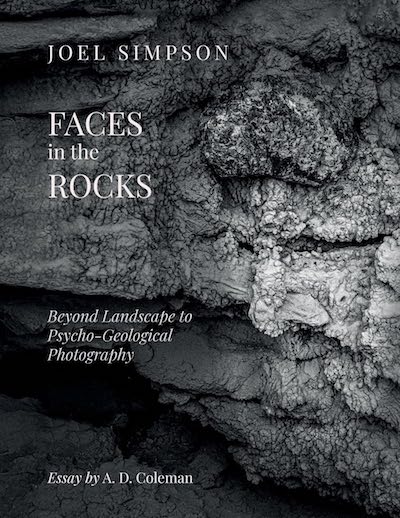
Joel Simpson, Faces in the Rocks (2026), cover
On June 8, 2026, I served as online interviewer of photographer, teacher, and jazz pianist Joel Simpson for a Zoom session sponsored by Artists Talk On Art (ATOA). This now appears at ATOA’s YouTube channel as “ATOA Dialogue: Photographer Joel Simpson with photography critic, author and historian A. D. Coleman.”
This session had as its main subject Simpson’s new self-published monograph, Faces In The Rocks: Beyond Landscape to Psycho-Geological Photography, for which I provided an introductory essay. This volume gathers the cream of Simpson’s long-term efforts to combine aspects of surrealism, abstraction, and pareidolia in a photographic practice that eschews the tropes of classic landscape photography. As Simpson writes, “The book includes 212 images and 28,000 words of text, offering a thorough theoretical and historical framework, as well as fully illustrated how-to and where-to-go sections.”
Click here for Simpson’s website, through whose bookstore you can purchase the book directly from him. For a complete online/ebook version of this monograph, click here.
•
NU26

NU26 logo
As noted previously, for some years now I have provided commentary on a shifting set of annual collaborations between a photography program at Yrkesinstitutet Prakticum in Helsinki, Finland, which sponsors and organizes the project, and other programs for vocational education students in the Nordic countries. The contributing students range in age from the late teens to the early forties.
Each year’s thematic project results in a group exhibition staged at one or more of the participating schools, plus an online catalog. The theme of NU26, this year’s project, which went online in January, was “Borders & Boundaries.” You’ll find my response to NU26 here, titled “Children Without Borders.” An excerpt:
… There’s no avoiding constant negotiation over where one thing starts and another stops. Arguably, that begins when we exit the birth canal, if not before. In our roles ranging from private individuals to public citizens, we exist within a latticework of overlapping and intersecting territorial definitions. Some take physical form: the surfaces and openings of our bodies, the signposts and fences demarcating where one state, region, or country ends and another begins. Others we term abstractions: gender, sexuality, political affiliation, religion, ethnicity, nationality. …
What if, this coming year, we drew a line in the sand between what was good for children and what was not? Children come into the world assuming it borderless and unbounded. Perhaps we might strive to reconceive it as did James Baldwin:
“The children are always ours, every single one of them, all over the globe; and I am beginning to suspect that whoever is incapable of recognizing this may be incapable of morality.” (“Notes on the House of Bondage,” 1981)
For links to the previous NU editions, NU20-NU25, with my accompanying essays, use the link to the current installment and scroll down to the bottom of the page.
P.S.: Speaking of Finland, I highly recommend reading “Finnish children learn media literacy at 3 years old. It’s protection against Russian propaganda,” an AP News report by James Brooks published on January 5, 2026. This is how democracy — in this case, a social democracy — can protect itself against the predations of corporate and governmental mass media.
•
Finally, because we all need a bit of relief from the incessant barrage of malign idiocy, this off-topic link lets you check out the 2026 Ig Nobel Prize Winners. Spend a few minutes pondering the odd areas of knowledge that today’s researchers probe.
•
This post sponsored by a donation from Carlyle T.
•
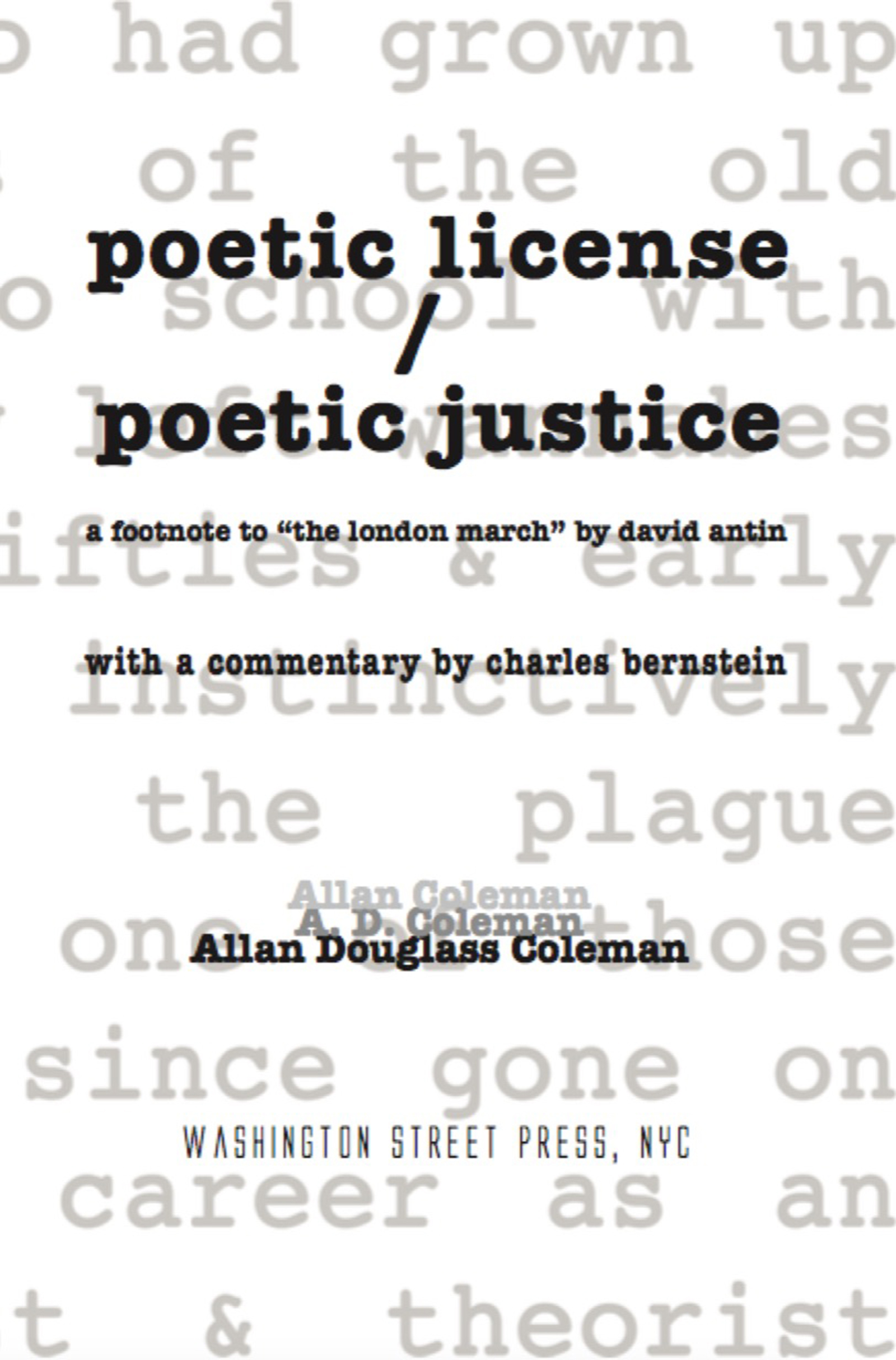
Special offer: If you want me to either continue pursuing a particular subject or give you a break and (for one post) write on a topic — my choice — other than the current main story, make a donation of $50 via the PayPal widget below, indicating your preference in a note accompanying your donation. I’ll credit you as that new post’s sponsor, and link to a website of your choosing.
And, as a bonus, I’ll send you a signed copy of my new book, poetic license / poetic justice — published under my full name, Allan Douglass Coleman, which I use for my creative writing.